Hugh William Frank Fuller 4 February 1933-23 January 2017
Hugh Fuller 1933-2017
Hugh was born in Wanstead, East London, and attended Forest School, Walthamstow, where his father Bob was also educated, at the beginning of the Second World War.
For reasons he never fully explained, Hugh hated the school and decided to find a way to escape. From his point of view the sporadic bombing raids were the only fun part of Forest, but he sacrificed these brief excitements by telling his mother how frightening they were, and was promptly moved to the relative safety of the countryside and a new school, Bradfield College.
Hugh went on to run the family building business, Fullers Builders, which has been established in Walthamstow since 1872. Over the years, Fullers undertook many projects at Forest School, including the Aston Block, Whitmore Building and the science laboratories, although under Hugh’s guidance the company became best known for specialist renovation work for clients such as English Heritage.
Having hated being a pupil at Forest School himself, Hugh sent both his sons, Patrick and William there, and later his daughter Alice was one of the first girls to attend the sixth form in 1978. There were many facets to Hugh’s life, he was in business with his cousin, Peter (another Old Forester), he was a member of the Worshipful Livery Company of Tylers and Bricklayers and a Magistrate in Forest Gate.
When he retired in 1996, Hugh and his wife Ann went to live in Southwold, involving themselves with many local projects. Hugh continued to have a passionate interest in buildings of all shapes and sizes, including the ingenious renovation of an old bakery, Ginger’s House, where he lived to his death.
Towards the end of his life he wrote these memoirs based on his experience doing his National Service in Germany, a favourite topic of conversation.
He left his beloved wife Ann of 60 years, five children Clare, Lucy, Alice, Patrick and William, thirteen grandchildren and two great-grandchildren as well as many friends from all walks of life. Hugh was a true gentleman and we all miss him.
I am a trainee quantity surveyor on holiday with my parents in Mevagissey, and I have just met the prettiest and most attractive girl that I will ever encounter.
I had experienced eleven years of boarding school, starting before my seventh birthday. I attended three schools; Forest School in Walthamstow, Carn Brea, first at Cranleigh, and then at Bromley, and then Bradfield in Berkshire. The teaching throughout was variable; it was wartime, and many capable teachers had joined the forces, but I eventually mastered most of the subjects I studied. I won a small grant – a mini scholarship – to my secondary school, and thereafter prospered at latin, maths and chemistry.
Father would have liked me to have gone on to university – I attended an interview at Cambridge where I was told that they were not prepared to consider me until I had done my two years of National Service. I was not keen on the idea in any case, and as I wanted to enter the family building business, I was lucky enough to secure an apprenticeship in the surveying office of a moderate sized building contractor in Stratford, East London, A.E. Symes Ltd. For this I obtained a deferred call up to my National Service.
A few weeks after leaving school, I was employed on a building site in Poplar, where I was treated with great kindness, if with some reservation; it was after all, a social upheaval for me and I was an object of curiosity for my new companions in the class conscious attitudes of the times. I found myself with blistered hands assisting the bricklayers, carpenters and plumbers; I was sent out to fetch rolls of felt, fixings and sky hooks, the latter a favourite leg pull in the industry.
The site was part of the 1951 Festival of Britain; the general foreman was Bill MacMonnies, a former bricklayer from Liverpool, a true gentleman, who kept tropical fish and seemed to find these more rewarding than his wife. They had no family of their own, and when I last heard of him, he had found work in the Virgin Islands where he was said to have gone with a female companion.
One of his men was a ganger, in charge of the labourers. He was an interesting character; he had enlisted in the army during the First World War aged fifteen or sixteen, and been sent to fight in France, where he admitted to killing the enemy without compunction; it was after all, what he had signed on for.
He was particularly proud of his summary execution of a tramp around 1930. On this occasion he had accompanied his sister, her husband and their two small daughters on a picnic on a river bank in Kent. After their lunch, the children wandered off, returning in tears because one of the girls had been attacked by a strange man. He and his brother in law set out to look for this person, and came upon a tramp whom they suspected might be the offender. They interrogated the man, who strenuously denied responsibility, and as they did not believe him, they threw him into the nearby river. When he swam ashore, he and his brother in law questioned him again. Again he denied responsibility, so they threw him in again. This continued until he admitted the offence, after which they threw him back and made sure he didn’t come out. To him this represented justice; he had spent his war service executing Germans who had done no wrong in his eyes, and he was now able to execute a man who was manifestly guilty, and to do so with the minimum of trouble and expense.
In the early summer of 1951, I was moved into Symes’ offices and started to learn to be a quantity surveyor; at the same time I attended part time day and evening classes, and even won a prize for being the second best building student in the London Region. In the summer of 1952 I was sent up to Warrington, where my employers were building a factory extension and enlarging the existing electricity generating plant for Thames Board Mills, a Unilever subsidiary.
I lodged in Stockton Heath, on the banks of the Mersey Ship Canal, at that time a busy waterway. My landlady was Mrs Ward, a dour and humourless Lancashire divorcee. I asked my fellow lodger who the man was who came every Thursday evening to watch television with Mrs Ward. Tom Dunbar replied that he was surprised that I didn’t know that he was Mrs Ward’s erstwhile husband.
At the beginning of August I left Warrington, and returned to the London office. I had not really enjoyed my spell in Lancashire, and asked not to go back, a request which was accepted. I then went on holiday with my parents and brothers to Mevagissey, where I met the girl who I immediately decided was the love of my life.
Unfortunately the life then became more complicated, as my new friend came from Cheshire, a formidable distance from where I lived, in London. At the start, I managed to obtain an invitation to the Warrington office Christmas party, and was able to call to see my friend in Knutsford, en route. Luckily the visit was a success, and emboldened by this, I forced myself to ask the chief surveyor, Harry Jones, for Saturday morning off; we normally worked until twelve on Saturdays. Harry Jones looked over the top of his glasses: “You can have it this time, but don’t let it become a habit, Fuller.” “No sir, of course not sir, thank you very much sir.” Well, not for another three weeks, anyway. Luckily I was able to borrow the family’s second car – an Austin A40 estate, or adapted van, and in the following spring I asked if I could return to Warrington, only a dozen miles from Knutsford, for another few weeks of training. Again I was lucky, and – apart from my friend’s occasional wish to terminate matters, all went well.
So life blossomed; every three weeks or so I drove North; no mean feat in the days before motorways, with a car with a top speed of little over 60 mph, poor roads and heavy goods traffic travelling in convoy at official maximum speeds of 20 mph.
In the spring of 1954, my friend’s parents invited me to go on holiday with them to Mevagissey again, and this time disaster struck. We all went, of course; the weather was cold and dull, and it was intended that my friend should come back to London afterwards and spend a week sightseeing. Alas, she decided that she had had enough. I was forced to return home on my own and it spelled the end of what I felt had been the time of my life. Although I made a number of attempts to revive matters, they all ended in failure. I became such a dreary individual that my exasperated parents eventually suggested that I should join my cousin, whose building career was parallel to my own, and do my National Service, albeit a year earlier than originally intended. In the event, this was what happened, and I duly had my medical (“Drop your trousers, cough, fair enough.”).
Before I started, I was invited to the wedding of a local friend, where I met a girl, (“The only trouble is, she is very similar to the other one,” said mother) whom I invited out two or three times. The last time we went out, I took her home to Welwyn Garden City where she lived. I was introduced to her parents who questioned me on my background and training. I explained that I was a trainee surveyor but expected to finish my apprenticeship and start my National Service in two weeks time. “What branch of the Services will you be joining?” asked the father. I explained that I was due to enlist in the Royal Engineers at Malvern. “Isn’t that where Jim is going?” he asked his daughter, to which she shrugged a non committal response. As this was the first mention I had had of Jim, I was mildly curious, but no more than that, and in fact I soon forgot about him – and her.
In early October I caught the train from Paddington to Malvern. I met my new companions at Malvern Station, where we were collected by a number of Bedford four wheel drive T.C.V.s (Troop Carrying Vehicles). Malvern was a hutted camp consisting of a number of single storey cement block structures, comprising sleeping accommodation, kitchens, mess buildings and stores, all connected by covered walkways.
We were kitted out with uniforms, boots, shirts, underwear, nightclothes, webbing and other equipment. We were given brown paper and string to parcel our civilian clothes and send them home. We were issued bedding, including blankets, sheets and pillows, together with the ubiquitous green lightweight, a fine woolen blanket used to cover the bed, chiefly for decorative purposes. Our basic uniform comprised khaki battledress blouse and trousers with boots, webbing belt and gaiters, black lanyard, jackknife and supporting cord, with khaki shirt and tie and dark blue beret. Additionally we were given hairy undergarments, socks, pyjamas, P.T. kit, greatcoat, etc., etc.
In the next few days we were inoculated – sitting astride benches in rows, while a medical orderly went down each side with a hypodermic, jabbing each man as he passed.
We were now Sappers, albeit amateur ones. We were initiated into the basic military rites; bullshit, obedience, cleanliness, survival. We quickly learned not to hold our china mugs in the arm that swung when walking to the cookhouse – the covered ways leading there were supported on concrete posts which allowed no carelessness.
After two weeks of rapid conversion into some sort of soldiery, we were allowed out of camp at the weekend to be reminded of how life had changed; I stayed behind.
The beret had to be shrunk for smartness, and then brushed either with a boot blacking brush or brass bristle brush to remove any suggestion of dust. All badges and buckles had to have casting imperfections removed and given a mirror finish using metal polish and cardboard. Boots were converted to appear like patent leather, by using Kiwi polish applied with a spoon heated over a lighted candle. The effect was ruined the first time one paraded by the soldiers behind and ahead.
MORVAL
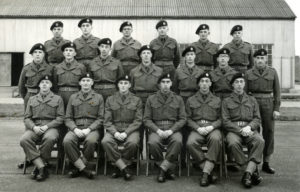
Cadets from Royal Engineers training regiment at Morval barracks towards the end of 1954. Fuller in middle row, second from left
Our next posting was Farnborough. This was a second home for the Royal Engineers, who had trained here on the outskirts of Aldershot since the days before the Royal Aircraft Establishment. Morval barracks was part of the Southminster camp, the other part known as Guillemont , both named after French First World War battles. The wooden buildings were known as ‘spiders’ – they comprised a central nucleus of ablutions and six parallel legs of accommodation huts, the whole layout taking the form of a giant insect. Away from these lay the parade ground, covered drill area, cookhouse, mess and administrative offices. Plenty of whitened stone edgings – “If it moves, salute it, if it doesn’t, whitewash it.” Grassed areas were frequently trimmed with jackknives, which resulted in a similar shorn appearance to the weekly shilling haircut. Whitewashing stacks of coal was an effective method of discouraging stealing from them.
The two corporals in charge of our troop at Morval barracks were called Ogden and Allen. The former had, I believe, worked in a saw mill, the latter on a construction site. Oggie was a hard taskmaster and generally unpleasant, Allen less so. They played the typical roles of the bad and good policemen. Towards the end of our training we appreciated the skill with which Oggie would manoeuvre our troop towards the refreshments van at the appropriate time, although this was presumably as much as, or more than, in his interest as ours.
“Bullshit baffles brains” The archetypal army truism. Our introduction to this ideal was contained in the instructions for keeping our room clean; “You are not allowed to add bleach to the water in the fire bucket, and applying boot polish to the pump hose is forbidden. However, this is the only way in which these items can be kept in good order.”
If cleanliness and Godliness are related as closely as was suggested, the Sappers must have been among the holiest of soldiers. Corporal Ogden would climb to the summit of the internal roof structure to check whether there was dust on the rubber insulated electric cabling, and the second lieutenant who occasionally inspected our hut once decided to beat our bed packs (the carefully contrived, permanent displays of sheets and blankets that represented what were supposed to be daily layouts) with his bamboo swagger stick, with predictable clouds of dust ensuing, and fatigues following.
If walking around camp with another soldier, both had to keep in step; naturally each had to salute if passing an officer, and in unison. (up, two three, down two three.)
At Morval we quickly settled to real training. Firstly we were indoctrinated into soldierly, and particularly Sapper, ways. To be soldierly you had to avoid athlete’s foot and venereal disease. The former appeared to be both more preventable and serious, so much so that several of us tried to obtain treatment for it before we were invalided out of the army altogether. Needless to say, it was not easy, as any attempt to report sick was made extraordinarily difficult; it entailed dressing up in one’s best uniform in full kit (webbing belt, pouches, and other equipment), and reporting to the guard room (regimental police with white webbing and a complete absence of any sense of humour, or justice or common sense, for that matter).
We were taught the Sapper song, which described the activities of two bygone second lieutenants or warrant officers (Mr Stevens and Mr Knight) and finished with a South African chorus of politically incorrect and unrepeatable tastelessness. The regimental march to which we were also introduced was an agreeable, possibly German, piece of music.
Denim overalls were used for all training activities, and, as smartness involved wearing baggy trousers over ones gaiters and boots, the laundry returns were fiercely competed for, and taller Sappers were often forced to wear calf length trousers.
We spent several weeks training in basic Sapper functions. The word “Sapper” derives from the name of the trenches or ‘Saps’ employed since medieval times to undermine enemy fortifications, and our training included trench digging in sandy ground that had been previously well excavated. This meant that the sides of any new trench quickly collapsed, doubling or tripling the effort needed. It was the only time in my life I used a wooden wheelbarrow, and as with much of the basic army plant, the effort required to operate it ensured a good appetite afterwards. Our food was excellent, much better than boarding school. It was supplemented by mobile canteens run by the Salvation Army (Sally Ann’s) and others, who supplied us with tea and doughnuts on the training grounds.
We were instructed in firearms; the Lee Enfield rifle, survivor of the First and Second World Wars, and the Bren gun, a semi automatic gun designed in Brno (Czechoslovakia) and made in Enfield.
Our camp was situated in a wooded area (fieldcraft) and adjacent to Hurley Lake (water based activity). We were given instruction in the use of pontoons driven by inboard motors.
One one kit cleaning occasion, I was in the cleaning room to hear Jim Pinnock describing his girl to his assembled friends. He obviously knew her much better than I did from the few times I had met her. I still puzzle how I recognized her, as I am sure he did not give her name.
At Morval, we were segregated into ordinary soldiers (‘other ranks’) and potential officer cadets (O.R.1s) who, as their title suggests, were to be given the opportunity of climbing the greasy pole of promotion. At the end of our basic sapper training, we were posted for a few weeks to Guillemont barracks to become involved in various informal schemes, initiative tests and exercises. These involved map reading skills, night manoeuvres and endurance marches. On one occasion a night exercise was cancelled and we were left with six pounds of uncooked sausages which we had hoped to barbecue. We managed to cook them in our hut the next day by using an (unregulated) electric clothes iron positioned upside down between two large steel kit boxes; the sausages were then fried in our aluminium mess tins. Neutralizing the cooking smell afterwards was difficult.
Returning from the exercise one night we were as usual singing in the back of the t.c.v. The side curtains were rolled up and the thirty or so voices made a good mobile choir. Unfortunately the song chosen was “The ball of Kirremuir” a rugby dissertation on the fate of a team of virgins who hailed from Inverness. Oggie panicked that the residents of Haselmere might not be prepared to discover the sequel, and in an instant this was changed to “Silent Night” with hardly a pause.
During a threatened national dockworkers strike, it looked likely that we would have to provide army transport to move freight, but this never materialised. Our first Christmas, for which we were all given leave, was celebrated beforehand with a party in the canteen. The cooks did us really well, and until, and even after, someone poured a pint of beer over the regimental sergeant major’s head, goodwill reigned throughout.
The potential officers were sent to the Selection Board at Barton Stacey. Here they were tested to destruction. “They check to see how you hold your knife and fork”.
We were given command tasks (how to lead a group over an assault course) lecture skills were tested (a five minute talk on “the bicycle”) and – most difficult of all, a ramped scaffold board set at a steep angle, which you had to run at fast enough to carry you to the top, five or six feet above ground. For me, this was a true test; on the one hand I could see it was clearly impossible, on the other I could see that failure would be a disaster. In the event, I reached the top more or less on my knees and fell over the edge, luckily landing on my feet.
Barton Stacey must have been one of the coldest places on earth the night we stayed there. I lodged with a member of the H.L.I. (Highland Light Infantry), who retailed gruesome tales about the Glasgow criminals with whom he was billetted. The only item I remember was the mirror he described on the floor of the guardroom which ensured that no soldier could exit wearing underpants beneath his kilt.
Luckily – and I do mean, luckily, I was considered suitable for further cadet training, when I had returned to Guilliemont. The successful entrants were then posted to Mons barracks at Aldershot, where other cadets from the non-infantry arms were given six weeks basic military officer training, which included drill, some by the famous/infamous regimental sergeant major Britain, aspects of administration, and military law. This latter item included an anecdote about a man and woman alone in a train compartment. The woman suddenly says to the man “Unless you give me five pounds, I will pull the communication cord (emergency stopping device), and say that you tried to rape me.” The man replies, “On the contrary madam, if you don’t give me five pounds, I will rape you.” I cannot remember the particular aspect of military law this illustrated, but it made the lessons memorable, if not the actual issue raised.
GILLINGHAM
After our six weeks at Mons, which were less rigorous than our Sapper training, we were sent to Gordon Barracks at Gillingham, an offshoot of the school of Military Engineering at Chatham where real soldiers trained. We travelled there by train. In those pre-Beeching years (?possibly still), it was feasible to go from Aldershot to Chatham by rail. When we reached Gillingham we were formed up in fine military style – after all we had been in the army all of three months, now. Sergeant Major McIver inspected us. He was less obviously impressed by our turnout, and explained that he was known as “Black Mac” for reasons that he would make obvious. He explained that there were two ways to complete our course; “The hard way, and the fucking hard way.” In fact he misled us; there was no choice, as the first alternative did not exist. We were given upgraded kit items – a white plastic disc behind our cap badges and white gorgette lapel tabs on our battledress collars.
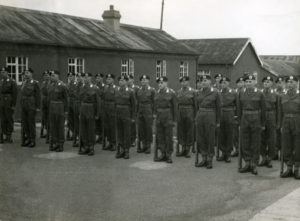
On parade in Gillingham: Royal Engineers cadets were often recruited from technical colleges and universities. Square bashing was our staple diet
However, life was good, work was hard, the food was excellent and the teaching staff were skilled.
We were drilled and exercised, taught bridging, rafting, roadmaking, lifting, explosives and demolitions. We were given handbooks on military engineering and instructions on amending them. In one instance, we were told to change the words from “rearming and refuelling (air) strip” to “refuelling and rearming (air) strip”. This made it clear how precise we had to be…
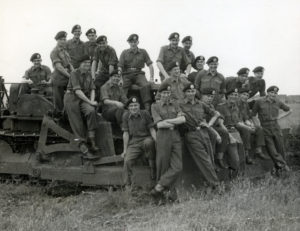
Hugh Fuller (back row, fourth from left) with cadets at Upnor training ground. Fowler bulldozer had cable operated shovel
Bridging was a major item. The Bailey bridge had been invented by a Sapper – Donald Bailey – and was still being used in parts of Europe as a temporary measure. It was simple and ingenious; the steel framed side panels were portable by six men carrying wooden supporting bars between their crooked elbows, and sometimes, on uneven ground, four of them carrying the panel while the other two hung down. Once, when launching a bridge, one of the cadets organizing the construction, found it sliding too far ahead – care had to be taken to make sure that more bridge remained behind the launching rollers to balance it, than projected across any gap.
The cadet supervising the operation, Peter Kearney, got into more trouble for shouting “whoa!” instead of “check” than for putting his foot on one of the rollers, which could have cost him his limb.
Water borne exercises were enjoyable. Building rafts tested the imagination; one comprising three fuel drums lashed together with boards and ropes to form a triangular craft worked satisfactorily until one of its crew changed his position with predictable (and wetting) consequences. Rowing cutters up and down the Medway was hard work and spectacularly badly done.
Water supply was another activity. I was detailed to supervise a water supply exercise, which included the erection of a steel tube tower with a reservoir on top. We landed the components – probably weighing about five tons – onto two three ton trucks. Unfortunately when we came to move off, one of the two truck’s bodies had sunk onto its’ rear wheels and so both had to be unloaded and the contents redistributed to overcome the problem. As the driver unwisely informed us, “I thought that might happen.” Eventually we managed to move off. The tower was erected as planned, and the inflatable storage container positioned on the top of it. The tower was diagonally braced for stiffening purposes, but unfortunately the bracing all ran the same way, and as the reservoir filled, so the tower started to rotate. However, as always, there were enough bodies around to hold everything together until the tower had been properly stiffened. When the whole project was erected we had to pump the container full of water from the nearby lake (pond?) and use a sufficient quantity of purifying tablets to prevent anyone dying from the obligatory consumption thereafter.
For demolitions we were taken to a disused fort beside the River Thames, erected by the Victorians to fire on the French Navy when it might sail up the Thames a century earlier. There we felled saplings with lengths of explosive cord, cut railway lines and made smaller craters with plastic explosive. Some of the cadets managed to retain a booby trapping device and some detonating cord, and bring it back to Gordon barracks. There they baited one of the latrines with a roll of toilet paper, and booby trapped the arm of the flushing cistern. When it was used, the device worked gratifyingly well, and the resultant explosion exceeded expectations, leaving an acceptably traumatised cadet.
Sport played an important part in our character development. I particularly remember two events. Firstly, regimental sports day, when I had to compete in the long jump. Due to an inexpert take-off – and landing – Mr McIver asked me if I thought I was a fucking ballet dancer.
We also had to undergo three round boxing contests with fellow cadets. We were allocated partners of similar height and weight and all generally agreed to make the fighting look aggressive and even painful, whilst not actually harming each other. I was paired with Beverley Fox, a young, keen, ex-public school cadet whom I particularly disliked, and with whom I now saw a chance to show my feelings. Unfortunately, these feelings must have been reciprocated, and even more unfortunately, Beverley proved to be a reasonably proficient boxer. I managed to (just) survive the three rounds, but had to struggle through a deluge of silver stars at the end.
Every month, one of the groups “passed out” or participated in a farewell ceremony. This comprised a parade, slow, in line, eyes right, march past the saluting base in extended lines, a left turn and march away. Unfortunately, during the eyes right past the saluting base, I lost my balance. Thankfully, and as I imagined, skillfully, I regained my balance but did not realise that I was out of step with everyone else. When we turned at the end, I found to my horror what had occurred, and to my dismay when we halted, Mr McIver held out his hand for my weekend leave pass “You ken why, do you not?”
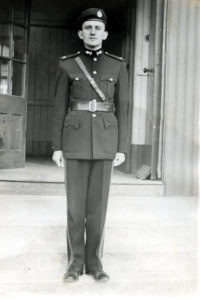
Finished article: Fuller in his officer’s dress uniform, bespoke tailored by Burberry at a cost of about £30 – the equivalent of seven weeks’ army pay
he asked. Indeed, I did, my friends took me to listen to a performance by Ted Heath of curent popular music to console me, which was excruciatingly noisy. It was our turn to pass out the next month. We held a passing out celebratory dance for, which I organised the decorations. Jim Pinnock’s girl friend from Welwyn came as his partner, and we exchanged smiles.
We had been asked what posting we would like. It was made very clear that the preferred destination for any real Sapper officer would be to an Engineer regiment. I put in for a works position where I hoped that I might gain experience in garrison maintenance which would help with my career afterwards. Naturally I was sent to the Transportation branch, otherwise known as Movement Control. (Buggerall movement and fuckall control) which at that time was largely responsible for the movement of troops across the North Sea from Harwich to the Hook of Holland, and then by train to Hannover through Germany by three separate routes. (Blue, green and red)
Germany in the nineteen fifties was being quickly reconstructed, unlike London, which was still awaiting repair. Although cities like Köln were still devastated, much was underway elsewhere. Unlike England, where food rationing was still a recent memory, eating out was a real treat, particularly the delicious fruit tortes and cream. With very few exceptions, the people were courteous and welcoming, possibly influenced by the proximity of their communist neighbours. Few soldiers spoke, or tried to learn the language, which did not really matter, as they led a different life and rarely mixed with the local population. It was a recognized jest that a biϊstenhalter was thought to be a bus stop, not a bra… Certain privileges were still available to the occupying forces; fuel concessions, and within garrisons, drink and tobacco were much cheaper. Many pre war cars were still in use, particularly two stroke D.K.W.s with fabric covered outer panels. When a V.W. full of drunken Belgians collided with a municipal tram with all the cars’ passengers dying in the ensuing conflagration, the wreckage was displayed in the town centre with a large board above warning of the perils of drinking and driving. Consumer goods were plentiful and varied, unlike in England.
I was sent to Mönchengladbach, a medium sized town near the larger new military base of Rheindahlen. When I reached my new post I asked what I was expected to do. “Don’t worry, you will be sent on a course at Longmoor in Hampshire,” I was told. Unsurprisingly I was never sent there, and I am still not sure what they would have told me to do had I done so.
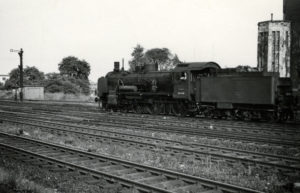
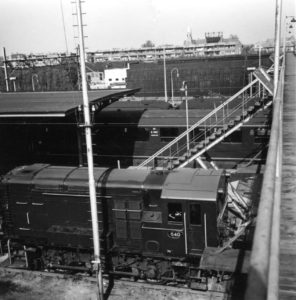
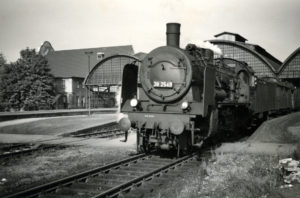
Local locomotives at the small regional German town of Monchenglabach, home to a sizeable British armed forces camp
My new commanding officer was Ben Reeve, a captain in the Suffolk Regiment. He lived in married quarters with his wife, Vera, a forces school teacher. Our offices were part of the Hauptbahnhof (railway station) complex, warm and comfortable. The staff comprised Ben, Sergeant Major Sallows, Sergeant Eglington, Sergeant Snell, Corporal Clarke, two Sappers, several displaced persons who handled baggage, a number of German staff who acted as interpreters and did all the administrative work, and a German driver. Among the civilian staff were whose English language skills were particularly good; Jim Hank and Harry Roten. Jim was the archetypal German, if not Prussian; erect, slightly stout, with short cropped hair, a cigar smoker. Harry was a young man who modelled himself on looking English, while wearing what he felt were English clothes (a bright blue woolen jacket, pale grey cotton trousers, and grey leather shoes). Jim had a slightly cockney twang, Harry, virtually no accent. I once asked how Jim’s English was so good; in spite of his obviously German background, he was in fact English, having been a staff sergeant in World War 1, who stayed on in Germany and married a German girl. He worked at the Ford factory in Köln during the Second World War. Harry’s English was almost accentless, and he always asked us to put him right if he mispronounced any words. He rarely did, however, and this was really the reason one would not think he was English – he had no regional accent. We had an army Volkswagen beetle: dark green with a folding roof, crash gearbox and cable brakes.
The workload was minimal. We had two military (steam) trains each day; one in the morning from the Hook of Holland, and one returning later, from Hannover. We had to see military and some civilian staff on and off these two trains, and occasionally we had to go to another station or depot to hand over paperwork for, perhaps, a consignment of tanks. We also had, once a week or so, trains to and from Klagenfurt, known as the Medloc express – Mediterranean lines of communication. At one time this had carried a slip coach which would be dropped at Mönchengladbach and then reattached to the Hannover train for onward re-routing to Berlin. Sergeant Eglington was said to have somehow contrived matters so that the Medloc coach was sent back to Austria where it had originated instead of Berlin, and attached the slip coach for Berlin to the Hook of Holland train.
As we were based at the nearest main railway station to the Rhinedalen headquarters, we had our fair share of VIP staff travelling through. Very often they would travel back on the evening civilian express, and frequently with their wives. It was not unusual to have to escort an elderly retired staff officer and his consort, find them their reserved seats, put their baggage on the rack, salute and say farewell. As the train only stopped for two minutes, it was usually travelling between five and ten miles an hour by the time we baled out, our studded boots skating along the platform
Mönchengladbach was a good posting; the actual mess was a large corner dwelling near the opera house, and our sleeping quarters were a short distance away in the the same road. The soldiery lived comfortably nearby. Those using the mess were from a variety of corps and regiments; the president was from the Royal Army Service Corps and there were officers from REME, a cavalry regiment, signals, sappers and others. The waitresses who looked after us were upmarket German ladies, and my batman was a middle aged German.
My first (monthly) mess dinner evening, when everyone wore ceremonial dress uniform, or “blues” ended disastrously. The second lieutenants from R.E.M.E. showed me the ropes, and we were treated to a good meal. At the end of it, and after the formalities, which included drinking the Queen’s health, we left the table and moved to the bar. On of my new R.E.M.E. friends then said that he’d had enough and thought he would leave; the other agreed. It seemed a trifle premature to me, but as they were more experienced, I assumed we would not be breaking any rules. Luckily(?) we asked the colonel’s permission first. Colonel Kennedy did not respond as we might have hoped. “Leave?” He asked. “Yessir”, “Why?” He demanded. One of my companions explained that we wished to go to bed. This proved to be the blunder of the evening. “Not only will you not be allowed to leave now, but I will personally ensure that you three will be the last to leave tonight.” End of story!
We could pay sixpence (old money!) to travel to the cinema by the garrison VW personnel carrier; at headquarters in Rhinedalen where there was an army and an RAF cinema.
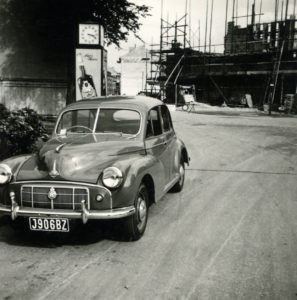
Drink was cheap: threepence old money for a single measure of spirits, and cigarettes were only eleven pence for twenty or a shilling for Players Perfectos – the ultimate smoke. Düsseldorf, Köln, and the Eiffel mountains were nearby. My CO’s wife introduced me to a young teacher friend, Joan Dawson, and life was very comfortable, improved further by the use of my car, a Morris Minor, which I brought over on the Dover to Calais ferry, and which facilitated viewing the locality.
We explored Düsseldorf night life with the help of a duplicated copy of “Bon Viveurs Alternative Guide.” We (the R.E.M.E. subalterns and I) were set on viewing a totally naked artiste, but disappointingly all we saw were ageing topless dancers, and drank expensive, poor quality, fizzy white wine. We went in Graham’s elderly Opel which had a front wheel tyre burst on the return early morning journey, luckily without any consequent problems. Graham worked at the local Rhine army workshops, where they reconditioned elderly half track vehicles. They told me the majority of repaired trucks failed before they had covered a thousand miles.
Suddenly everything changed. I received a letter from England which reminded me why I was where I was when I was. Ann had written asking after me. She did not know I was in the army and in Germany. I replied cautiously – she said insensitively – saying that I would be pleased to meet her in Düsseldorf any time she happened to be there. I did not want to sound too eager and to find that matters had not really changed.
However the next letter I received told me that she had borrowed a hundred pounds from her mother and was indeed coming to Düsseldorf as soon as it was convenient.
I arranged with Vera Reeve to put her up, and with Ben for me to take time off to show her around.
I met Ann off a Dakota of the British European Airways flight. We went to Köln for a day’s outing, climbed the southwestern cathedral tower, I proposed and – luckily – was accepted. We visited a jewellers in the devastated city, and bought a ring. We returned home to Mönchengladbach way of Monschau in the Eiffel Mountains and spread the glad news. Mother and father were shocked: they thought a long engagement would be sensible. Ann did not agree, and nor did I, for I didn’t want her to have the opportunity of a further change of heart. We eventually settled for just under a year; effectively, as soon as I was demobilised. Reports upon the arrival of my letter announcing my betrothal varied – one of my brothers said father was enthusiastic, but both agreed that my poor mother was distraught (wait and see, she’ll do it again!).
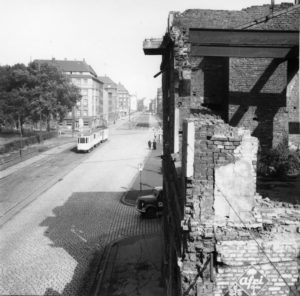
Dortmund 10 years after the end of the war. Reconstruction was well under way, although much remained to be done
Soon after this I was told that I was to be posted to Dortmund as Rail Transport Officer in my own right. This was an enviable post; some fifty miles from headquarters; the station served a number of regiments in the area, including infantry a local Field Engineer regiment, a survey squadron, and an armoured regiment. My predecessor, John Launder, showed me around, and although he had struck up a strong friendship with the neighbouring Canadian R.T.O. is Söest, I soon made my own, different, acquaintances. I moved in with the local garrison, which had a similar complement to the one I had left at Mönchengladbach, and life began again.
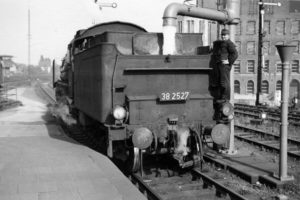
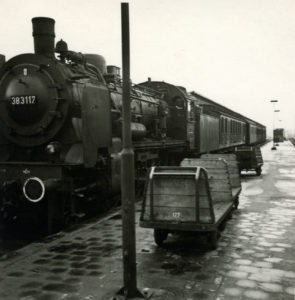
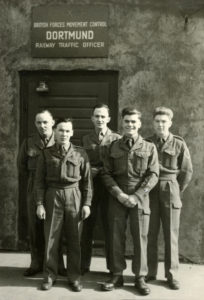
Local train at Dortmund station, heavily bombed in the warFrom back row left: Sergeant Major Carol, Second Lieutenant Fuller, Corporal Martin; front row: Sappers Morley and Mitchard
Dortmund had taken a hammering from the RAF. It was just over ten years since the end of the war, and reconstruction was well under way. The R.T.O.’s office was on platform four, and comprised two small rooms. The innermost was occupied by the German staff, who did all the clerical work. Well, all the work, really. The outer office was for the military. These were myself, Sergeant Major Carol, Corporal Martin, Sappers Mitchard, Howe, and Morley. There was also Karl, the German driver, who was generally disliked by everyone else. Commonly supposed to be an ex-Hitler Youth member, Karl lived with his mother who was considered to be far too tolerant of his louche behaviour.
Corporal Martin felt a particular antipathy towards Karl, and discovered that he regularly used the unit’s Volkswagen to travel home at lunchtime. Corporal Martin pointed out that Karl had adapted his work tickets to accommodate the extra mileage, and painted a colourful picture of the result of any investigation. How likely this might ever have been, I have no idea, but the upshot was that it was considered better to rid ourselves of Karl before anything happened.
Fuller’s personal Morris Minor, which he drove 375 miles from London to Dormund, solving his transport challenges
After Karl left, we had no driver, as no one one else held a licence, and I had to take his place, although it was considered unadvisable for officers to drive, in case of any additional embarrassment in the event of an accident. I drove for some time, while waiting for a replacement for Karl. On one occasion we had to go out in the middle of a very cold January night to supervise the entrainment of a squadron of tanks some distance away, and the V.W. refused to start. The only way I was able to move it was to ask the regimental fire picket to tow it around the camp until it came to life. Eventually we were given another civilian driver, Helmut, and the problem disappeared.
Life at the garrison was very relaxed; the small amount of work was similar to Mönchengladbach – two trains each day, and some freight traffic, but no V.I.P.s.
Mr Carol generously invited me to snooker in the sergeants mess. Karl collected us by car each morning, took us back for midday meal and back again to the garrison at the end of the day. There was little activity in the office, and by way of diversion, I organised a visit to a local coal mine, a steel works, and once a visit to the Volkswagen factory in Wolfsburg. On each occasion we were generously entertained with food and drink by our German hosts. The mine was very modern; I had long wanted to visit one, and the Germania was impressive. I was surprised by the brick lined tunnelling at the foot of the main shaft; I was also surprised to hear that Welsh miners were working there. The actual horizontal shafts sloped about 10” and the headroom was about 5’.
We were shown over the steel works at Duisberg at the same time as a party of cadets from Shrewsbury College, and the lad I sat opposite at lunchtime came from Knutsford, and knew Ann’s family.
When we went to Wolfsburg we were given lunch in a local hotel where I saw the only piano roll instrument I have ever come across. This was a long journey – some two hundred miles each way, and even on the Autobahn it took at least four hours each way.
The two bilingual German clerks were Herr Bock, a wild looking escapee from the East, whose mother had avoided rape by the Russians by convincing them that she was suffering from venereal disease, and Manfred Pladdies, a younger ex soldier who became a good friend. Manfred had fought in Russia and Italy, as well as on other fronts, and had been quite badly wounded in the neck; he had a glass eye. He kept the bullets that had been removed from his body on a table in his living room. His memories of the war in Russia included waiting for a dawn attack and seeing some ripe apples growing on the other side of a wall behind which his troop was sheltering. As they were all ravenous, one of his companions decided to jump over the pick some fruit. His reward was to land in a midden and to finish up covered in slime – catastrophic in the circumstances, where no washing facilities existed.
Although I had lived through the Nuremburg Trials of the Holocaust perpetrators, I do not recall reading about these events at the time. While at Dortmund I read a copy of “The Scourge of the Swastika” by Lord Russell of Liverpool, which was a detailed account of the atrocities, and was horrified by them.
I discussed the book with Manfred and his fiancé Elfriede, which I lent them. Their reactions were interesting; they largely accepted the truth of the accounts, but implied that these were exaggerated and even wrong in some respects such as the Nazi female official who had fashioned lamp shades from the skin of victims. As far as Manfred was concerned, they had been aware of the persecution, but not the full extent of it, and whilst not condoning the terrible treatment meted out, like many other Germans believed that many victims were gypsies, psychopaths, homosexuals, and other persons considered undesirable by the German authorities. I think it would be fair to say that like many of their countrymen, they were unwilling to believe that their nation could actually behave in such an amoral fashion.
Manfred and Elfriede, who said that she had once shaken hands with Hitler at a pre war Nazi gathering, lived in Essen, where I was regularly invited to tea on Sundays. They eventually married, divorced, and came together again, in spite of Manfred’s drink and woman problems. Years later Manfred became Godfather to our youngest son; when he was around six years old, Manfred and Elfriede visited visited us in London. Manfred was sitting in our kitchen, drinking coffee and surrounded by William’s young friends all agog at speaking to a real German. Manfred says to them all: “I tell you what, we Germans are tough” and taps his glass eye with a fingernail. His audience immediately vanishes….
One weekend Manfred invited me to spend a couple of nights with his sister and brother in law, Herr Doktor Bals, in Wiesbaden. I had an enjoyable weekend; we visited Frankfurt where I took Pam, a friend from home who worked at the embassy, out to lunch. In the evening we visited the local casino; I lost a pound (!) Manfred, I am sure, quite a lot more.
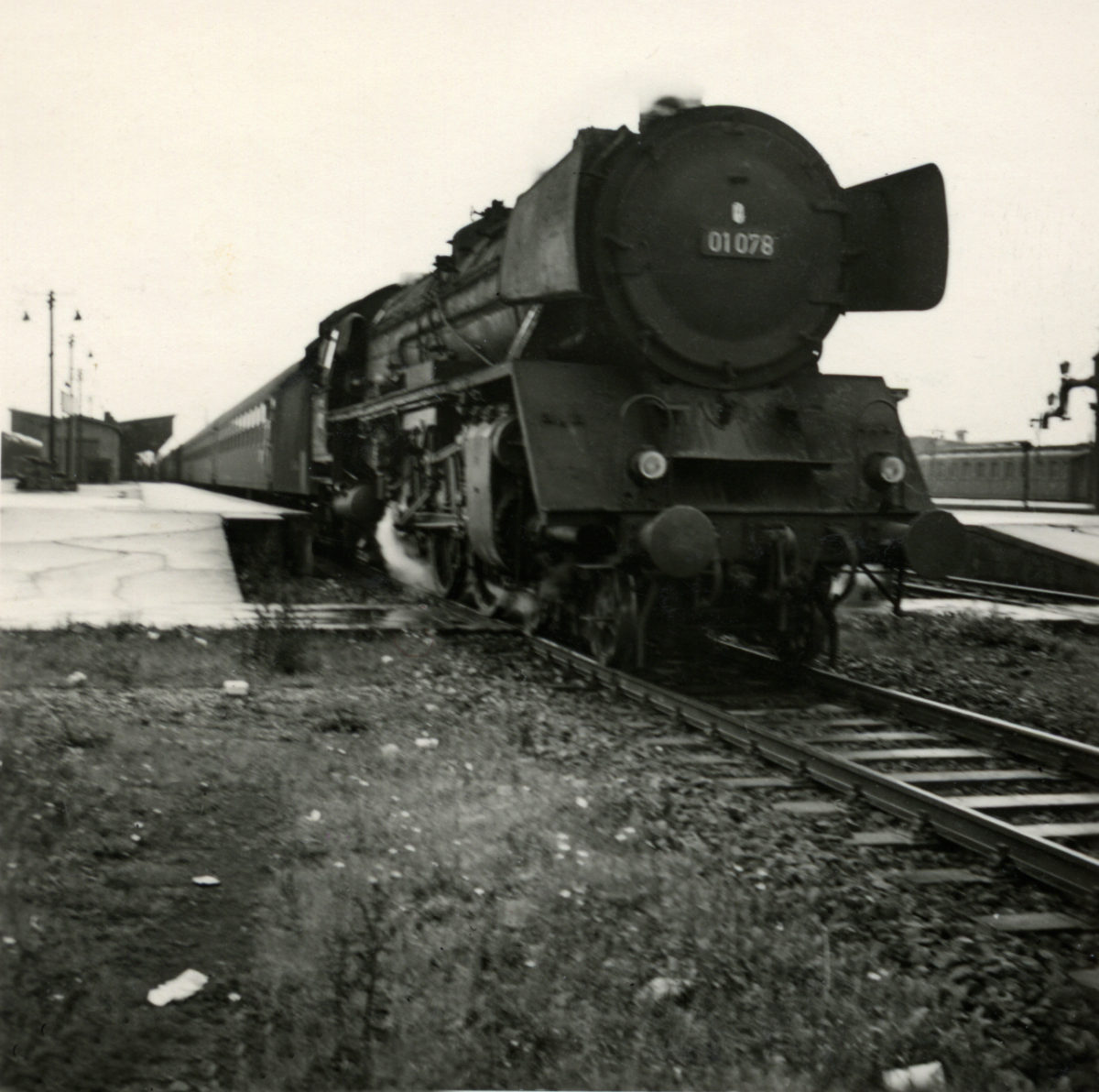
Manfred arranged the trip on the footplate of a steam locomotive such as this one in Dortmund station
Manfred also asked the driver of an express if I could sample a ride, and I travelled into Hamm on the footplate. The Germans, as ever, were proud to demonstrate the capabilities of their locomotive which I was told had a speedometer – unlike (?) an English engine, and which showed we were travelling at speeds of nearly 100 kph. The feature that struck me most forcibly was the sway of the engine itself as the connecting rods pulsated on each side. I was able to travel back to Dortmund free, and quite sedately as a passenger in a local train.
After living in the garrison for several months, it was decided that we would all be better off billetted with the local Sapper Regiment – 23 Field Engineer Regiment. They were quartered in the Luftwaffe camp; a very comfortable place; where the lofty officers mess dining room had a musicians gallery at one end.
I there met the second murderer of my acquaintance, a first lieutenant, Peter Poole. He was originally from Essex and had served in the African Police before joining the army. He was almost universally unpopular for his abrupt and arrogant manner; he was the butt of any spiteful horseplay on mess nights. Some time after I left the army, a man of the same name was accused in Africa of murdering his house boy who had been taunting his dog, and who turned out to be the same person. Peter Poole was tried, found guilty and sentenced to death. Peter, however, knew that his offence did not warrant such a reward, and was completely confident that the Queen would grant him a reprieve. Unfortunately for him, the wind of change was blowing in Africa, and the colony was emerging as an independent state. Peter Poole was duly hanged.
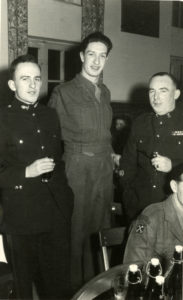
Fuller (left) with Sapper Howe and Sergeant Major Carol in dress uniform at the ex-Luftwaffe barracks in Dormund
I met a Sapper officer many years later at a City of London lunch. We got talking, and I recognised his name – a major, subsequently colonel, Perkins. I asked him if he had known Peter Poole, and I was curtly informed that Peter had been in his squadron, and had been a good friend of his and of his wife…
I was able to visit the local tourist sights, which included the picturesque Rhine valley and the Eiffel forest. I went to a pony trotting event and with another R.E. lieutenant to sail across the Möhne dam. Unfortunately during this last outing, my companion wound up the centreboard of the army dinghy so vigorously that it somersaulted out of the bottom of the boat, and disappeared. Luckily, the loss was overlooked.
In the summer of 1956, 28 Field Engineering regiment staged a ball. This was a spectacular affair – it lasted throughout the night and finished with a generous breakfast.
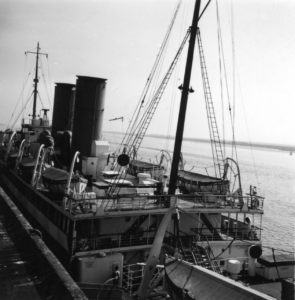
Hook of Holland dockside from roof of the embarkation sheds. Inter-war ferry was typical troop transport
The Suez crisis erupted. Reservists were sent out from England to retrain in Germany, and Movement Control staff were sent down to the Hook of Holland to help handle the extra traffic. The two troop ferries; the Vienna, a converted civilian ship, and The Empire Wansbeck, which I believe had been a minesweeper, did double trips, and an extra tho
usand or so troops arrived each day in the early evening. The usual boat arrived every morning and the RTO staff ate breakfast in the mess before seeing the trains filled. They then ate a second meal on the train. They were served by the ‘wagon lits’ staff; the food was no problem to eat, as we all had risen early, and had usually completed our day’s’ work by nine or ten in the morning.
Trains at the Hook of Holland, where Fuller served on the Rail Transport Staff and helped to marshal troops from boat to train
The Hook was comfortable; we lived in Nissen Huts and except when the troops were actually moving through – breakfasts for a hundred or a thousand, depending upon North Sea weather – we were chiefly left to our own devices. We visited Rotterdam, Scheveningen, The Hague and areas of Holland, made easier for me by having the use of a car.
To transport the reservists into Germany, additional daytime ferry sailings were arranged and supplementary military trains run to deal with the extra numbers.
The soldiers themselves were poorly disciplined. There was not much enthusiasm for the Suez adventure, and many of the troops were in the logistical branches rather than front line soldiers. They came ashore in the warm August weather wearing their battledress blouses, but unbuttoned, and with their berets tucked under their epaulettes. Their non-commissioned officers were disenchanted with their return to the military environment that most of them thought they had put behind them when they had been demobilised. I do not remember how the officers appeared, but the overall impression was of an unwilling and unhappy group of conscripts. Unlike recruits coming in for the first time, they had seen it all before, and resented this attempt to recall them. The regular army warrant officers however, had no trouble in handling them.
One evening, the first train came into the platform early. Sergeant Major Webb jumped off and came down the platform.
“Evening, Mr Fuller – what time do I go back?”
“Nine o’clock, Mr Webb.”
“I’ll just go down to the NAAFI, and have a cup of tea.” Mr Webb disappeared
The second train came in a few minutes later, Sergeant Major Bird came down the adjacent platform toward me.
“What time does the train leave, Mr Fuller?”
“Nine o’clock, Mr Bird.”
Mr Bird followed Mr Webb to the NAAFI. Unaccountably, although I knew the first train left at eight forty five, I had given both men the time of the second departure, with results that would shortly become all too apparent.
The reservists now trailed onto the platform. Although soldiers were never marched up to the train, these men somehow managed to make the whole operation informal to the point of indiscipline. They were commanded by their own NCOs and officers, and their behaviour among themselves was no concern of mine, but I was thankful that there was a regular army warrant officer commanding the train.
The Dutch railway official came up to me when everyone was embarked and asked if everything was ready for departure. I confirmed that it was, whistles were blown and the train load of what I privately thought of as a football type hooligans slowly moved away.
Just as the tail lamps of the last coach disappeared from view, Mr Webb came panting up the platform. This time he didn’t even waste time on a perfunctory salute.
“What time did you tell me my train was leaving, Sir?”
A nasty moment. However, it was clearly my fault, so I might as well admit it straight away.
“I told you nine o’clock, Mr Webb, but I should have told you eight forty five.”
“What should I do now, Sir?”
This was a real poser, but there seemed to be only one practicable solution.
“Don’t worry, I will have the train stopped.”
I could clearly see the result of leaving a trainload of reservist vandals careering across Holland and Germany with no responsible person in charge. My imagination drew a picture of a train with all the fittings loosened – perhaps thrown out of the windows. The reservist officers and NCOs would have no chance against this band of potential mutineers. The guard even less so. I would be the person ultimately responsible for this disaster which would reflect upon my Corps, the British Army, England…
I hastily found the stationmaster and explained what I wished him to do. He did not seem wholly enthusiastic about my proposal, but agreed to arrange to have the train halted.
Unfortunately this proved to be rather less easy than I might of imagined. To just stop a train that has had its path arranged all the way to Hanover is not like stopping a bus and asking the driver to hang on for a few minutes as the conductor has been left behind.
They did indeed manage to stop the train; by the time a suitable place had been found, it had reached the Dutch border about an hour away from the Hook. The stationmaster approached me with a blank expression on his face, and asked me what I would like to do next.
I explained that I would send the sergeant major to catch the halted train. I arranged for Mr Webb to be taken out in one of the garrison Volkswagens, and when the driver returned about midnight, he told me that Mr Webb had caught the train, which as far as he could tell, was still in one piece.
I was pleased at this successful outcome of my rescue plan. With no help other than the resources I had called upon, I had avoided a mutiny and saved the day. If one overlooked the fact that the whole problem had been caused by my own incompetence, the way it was dealt with showed a flair for prompt decision and supporting action.
I did not ever consider it necessary to make a formal report about the evening’s events to my superior officers. In the light of subsequent events this might have been considered less than prudent.
Ten days later I was given a message to report to Major Butler, my commanding officer.
I had no premonition of any problem; and when I entered Major Butler’s office, he was, as ever, courteous and pleasant.
“Good morning Fuller, I expect you know why I have asked you to come and see me?”
I had no idea at all. My escapade with the halted train was past history, and I had managed to put it out of my mind. The second train had left on time, and if I thought about it at all, which I doubt I did, I would have considered the whole event nothing more than a slight administrative hiccup.
“The Dutch Railway authorities have reported that a military train was delayed at the Dutch Border for nearly two hours the other night on your instructions; can you explain to me what happened?”
My stomach felt as if someone had just punched it. However, the facts were straightforward enough, so all I had to do was explain what I had done.
“Well, Sir. There were two trains returning to Germany that evening, and for no reason other than my own stupidity, I told both TCWOs that their trains left at nine o’clock, when in fact one left fifteen minutes earlier. As a result, the first train left without anyone in charge, and I felt the best course of action would be to stop it and send the sergeant major out to catch it. Dutch Railways were unable to stop it any earlier, but I had hoped that my actions would be the best solution to the problem.”
Major Butler rubbed his chin.
“I appreciate your frankness Fuller, but the War Office have received a bill for £600 from the Dutch Railways, and I think we will have to think of a rather better excuse than the one you have given me. You may go.”
I went. I never found out what his story was, but the bill was never passed on to me, for which I was truly thankful, representing as it did nearly three years pay!
When the time came for my demobilisation, I had to return by the civilian ferry from Calais. I asked Major Butler what formalities I had to undergo, and he said “Just leave”. I could hardly believe it could be so simple, but as it was an order, I left.
I was due to be married in two weeks time, and when I reached home everyone was busying themselves for the forthcoming event, which was to be in Cheshire, which for my family was as remote as the Trossachs.
On the Thursday after my return, I had a message to contact the War Office. When I returned the call and gave my name, I was told that I had orders to report to Longmoor Camp the following Monday. “But I am due to be married in two weeks time!” “Can’t help that, the orders are clear and confirmation is in the post.” I assumed that the problem was yet another consequence of the Suez upheaval, but my whole family went into panic mode, as may be imagined. Luckily I had a solicitor uncle, who had a contact at the War Office who was persuaded to look into the matter. The result was that a lieutenant Fuller had indeed been given a posting to Longmoor, but that this lieutenant H. Fuller, had omitted to surrender his army paybook before leaving Holland. And would he please send it on to the appropriate War Office department?
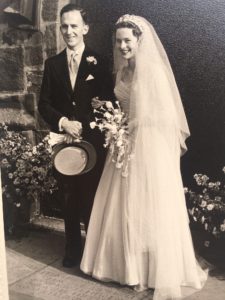
Hugh and Ann Fuller on their wedding day on 13 October, 1956
I was married on the 13th October, and life changed once more asAnn and I set up house in Walthamstow in East London. I returned to work for my old employers, commuting into Stratford each day, and returning to attend classes several evenings of the week in order to complete my unfinished exams. My paternal uncle, who ran half the family building business, became a widower at the end of the year, and decided to retire; my cousin and I then joined the company, and continued to work for it for some forty years. Ann and I were fortunate in having five children. The business (generally) prospered and survived until the late nineteen hundreds, when my cousin and business partner decided to retire.
My father’s other tale of travel, also a wartime event, was a particular favourite, as he felt he had been delivered by a Divine Providence.
It was 1942; he was now a captain in the Pioneer Corps, and had been posted to Sierra Leone. He was sent to Liverpool to catch a ship and he and another officer were duly sent by launch onto a waiting trooper. They had barely been aboard when a message came over the loudspeaker system telling both of them to report immediately with their baggage, to the Embarkation Station Staff Officer, ashore.
Fortunately, the launch had not left the ship and was able to return them to the dockside.
When they reported to the E.S.O., he asked them what they wanted. When they replied that they had come in response to his summons, they were told he had no idea what they were talking about and told him to return to the ship.
The ship had sailed – it was subsequently torpedoed, Father was told – but the two men travelled by a later boat to Freetown without any further problems.
My earliest recollection of the vagaries of military travel was my father’s homecoming on leave during the winter of 1940/41. Father, who had worked in the family building business for some 10 years, had enlisted in the Territorial Army in 1939, and hoping that his experience in the construction industry might be of use, had joined the Royal Engineers. He was naturally assigned to a searchlight unit, in which he remained for several months until the army decided that searchlights were more appropriate partners for the anti-aircraft gunners, and he was transferred to the Royal Artillery.
At the time of his leave, he was a sergeant in the orderly room of a regiment in the North of England and was travelling home to London via Coventry. He managed to find a seat in a third class compartment, put his belongings, including his greatcoat, on the luggage rack, and made himself comfortable. As he leant back in his seat and prepared to nod off, the door to the corridor was opened, and with some dismay he recognized the adjutant with whom he worked signalling his attention. The adjutant asked him if he would leave his seat and join him in the First Class compartment further down the train. Father pointed out that as an N.C.O. he only had a third class travel warrant and that he was unable to accept his invitation.
“Nonsense” replied the adjutant “I will speak to the ticket inspector and make things alright.”
Against his better judgement, father agreed to the move and made his way down the train. When they reached the First Class compartment the other occupants comprised three civilians, two of which turned out to be friends or colleagues of each other; the third, a somewhat taciturn individual, was a stranger to everyone else.
The two who were acquainted halted their conversation upon the entry of the newcomers and then resumed their discussion on the shortcomings of the wartime railway systems; their poor punctuality, lack of cleanliness and generally low levels of service, with plentiful examples of experience to illustrate their complaints.
After a while there was a pause in their diatribe, the third civilian; who had previously remained silent, spoke. “Excuse me, gentlemen, I could not help overhearing your remarks about the state of the railways, and as I work for them, I feel I should say a word in their defence.”
The other two rounded on him. “You would make excuses, wouldn’t you.”
The railwayman demurred, “Seriously, the railways have had to deal with enormous problems. They were starved of investment during the inter-war years, and when this war started they suffered a drastic shortage of staff due to enlistment. They experienced a shortage of supplies, and have had to deal with above average damage from the enemy bombing campaign.”
The other two were not mollified. “You are bound to make excuses if you work for them. They could do a lot better if they were properly organized, in the way that the industry for which we work gets to grips with problems.” And so on…
The railwayman waited for another pause “Have you been warned of the problems to expect tonight?”
“No, and this bears out the validity of our argument; what problems?”
It was at this time about seven p.m., a dark winter’s night.
“The railway system has been warned by the authorities of impending air raids in the Coventry area and as a result this train will be diverted, and will not unfortunately stop at Coventry.”
“But we are travelling to Coventry! This is the limit. Not only dirty and slow, but totally unreliable.”
“However, I hope that I may be able to improve your gentlemen’s opinions of our railway, as I may be able to help you reach your destination with the minimum of delay.”
The railwayman explained that although the original scheduled arrival time in Coventry was eight twenty p.m., it had been found necessary to divert the train to travel through Rugby, and to allow passengers to alight there instead. Protest ensued from the other two: “This confirms our worst fears”, etc.
“Due to an improved journey time we will be travelling around Coventry earlier than originally expected and we will be going through a station not far from the city centre at around seven fifty p.m. The train will not stop here, but will slow to a walking pace. If you throw out your baggage and jump out onto the platform you will only be a few minutes’ walk from the main station and you might actually arrive there earlier than originally expected.”
The two companions thanked him in rather grudging terms; one observed to the other it would be good if they reached their homes early, and how pleased their wives would be. A desultory conversation ensued and some of the passengers slept.
At half past seven, the railwayman explained that he had to leave the train in the Birmingham area, and took his leave of the others. Before he left he wagged his finger at the two civilians and reminded them to follow the instructions he had given them: “Get off the train at ten to eight and you will be there in good time.” The train rattled on its way.
Just after a quarter to eight, the brakes of the train ground on, and the coaches slowed. The two companions checked their watches, agreed that events were proving to be as expected and left the compartment.
Being wartime, the platform lighting was minimal. The two soldiers moved the roller blinds slightly and saw a platform appear alongside. The train slowed down to what seemed a snail’s pace and two figures landed on the paving outside. As the station fell behind the train picked up speed and settled on its way.
Half an hour later, it slowed again and stopped. Father and the adjutant pulled the blinds aside expecting it to be Rugby Station, but when they eventually managed to identify a sign, it was Coventry….
Father’s other tale of travel, also a wartime event, was a particular favourite, as he felt he had been delivered by a Divine Providence. It was 1942; he was now a captain in the Pioneer Corps, and had been posted to Sierra Leone. He was sent to Liverpool to catch a ship and he and another officer were duly sent by launch onto a waiting trooper. They had barely been aboard when a message came over the loudspeaker system telling both of them to report immediately with their baggage, to the Embarkation Station Staff Officer, ashore.
Fortunately, the launch had not left the ship and was able to return them to the dockside.
When they reported to the E.S.O., he asked them what they wanted. When they replied that they had come in response to his summons, they were told he had no idea what they were talking about and to return to the ship.
The ship had sailed – it was subsequently torpedoed, Father was told – but the two men travelled by a later boat to Freetown without any further problems.
 ad I done so.